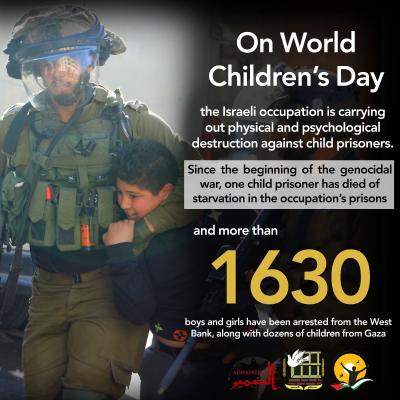
Prisoner institutions: On World Children’s Day, the Israeli occupation is carrying out physical and psychological destruction against child prisoners.
Since the beginning of the genocidal war, one child prisoner has died of starvation in the occupation’s prisons, and more than 1,630 boys and girls have been arrested from the West Bank, along with dozens of children from Gaza.
Ramallah – 20/11/2025 – On the occasion of World Children’s Day, the prisoner institutions (the Commission of Detainees and Ex-Detainees Affairs, the Palestinian Prisoner’s Society, and Addameer Prisoner Support and Human Rights Association) stated that the Israeli occupation system continues to inflict physical and psychological destruction on child prisoners through a series of systematic policies. Over the past decades, the Palestinian child has remained one of the groups most exposed to Israeli violations, including killing and injury, deprivation of education, night raids, and arrests that have targeted tens of thousands of minors since the beginning of the occupation.
The child has never been spared from policies of repression; rather, they have always been at the heart of the confrontation, paying the price of living under a reality shaped by colonial control that makes no distinction between young and old. Nevertheless, what has taken place since the start of the genocidal war marks a dangerous and unprecedented turning point. The occupation has escalated from a continuous level of violations to an intensified and systematic level that targets childhood with far greater severity. This comes within the broader genocidal war in which the occupation has killed tens of thousands of Palestinian children, and the issue of prisoners—including child prisoners—has become an extension of this ongoing genocide.
Since the outbreak of the war, human rights organizations have documented more than 1,630 arrests of children in the West Bank, including Jerusalem, within a short period of time. In addition, dozens of children from Gaza were arrested during the war and subjected to organized crimes, enforced disappearance, and denial of family visits—measures that have prevented any clear determination of their exact numbers. These facts illustrate the scale of the escalation and the widening scope of the targeting of children.
These children were not arrested in isolated contexts or through any lawful procedures; rather, they were taken during military raids, amid confrontations, from checkpoints and streets, and even from schools and their surrounding areas.
Today, around 350 children—including two girls—are imprisoned in the occupation’s jails, held in conditions that completely violate all international standards for the protection of minors. They are subjected to torture, starvation, medical abuse, and systematic deprivation and dispossession, in addition to collective isolation.
Child prisoners were a direct target of the retaliatory policies intensified by the occupation inside the prisons. Recent testimonies from released children confirm that the occupation authorities deliberately subjected them to complete isolation from the very first hours, separating them from other sections. Dozens of testimonies have documented their exposure to severe beatings and direct abuse throughout their detention, under harsh and degrading conditions. Documented data indicates that the vast majority of detained children were subjected to at least one form of physical or psychological torture, within a calculated system of violations that flagrantly contravenes international law, humanitarian norms, and all conventions pertaining to the protection of children and their rights.
The nature of the violations and crimes inflicted on children from the very moment of their arrest demonstrates that the occupation treats them as a “security threat,” not as children in need of protection and care. From the violence during raids, to excessive restraint, to the harsh transport conditions in the “bosta” vehicles, followed by interrogations without a lawyer or family member present, and then the overcrowded cells, lack of medical care, denial of visits, and deprivation of education—these practices reveal a systematic pattern. While such measures are not new, they have become far more severe, widespread, and deeply damaging to the lives of detained children since the genocidal war began.
The first moments of arrest:
The moment of arrest begins in the early hours of dawn, when Israeli occupation forces storm homes without warning. Families awaken to the first shocks: explosions, doors being smashed open, and soldiers’ shouting filling every corner of the house—leaving children suddenly confronted with a terrifying scene beyond their ability to comprehend or process.
The door is forced open, and children are ordered to get up immediately, often still in their sleepwear, and are made to stand in silence or sit on the floor—sometimes for hours. During this stage, personal documents and phones are confiscated, and the child and their family are informed of the arrest decision, without any clear explanation or specific charge.
In many cases, injured or sick children are denied access to their medication or necessary medical care, sometimes for an extended period after the arrest.
After that, the children are taken outside the home toward the military jeeps, where they are handcuffed and prohibited from moving or speaking. They are sometimes beaten or kicked while being transferred over long distances between checkpoints and military facilities. This marks the beginning of the first stage of enforced disappearance, during which the family is prevented from knowing the child’s whereabouts or condition—just as happened with dozens of children from Gaza.
The interrogation phase… confined spaces and continuous violations:
The interrogation stage is one of the harshest phases in the experience of child detention under the occupation. It is conducted in an environment deliberately designed to break children’s will and extract confessions from them. Children are held in conditions lacking the minimum requirements for human dignity and are subjected to long hours of continuous questioning without the presence of their parents or a lawyer.
Numerous testimonies indicate that this stage is exploited to intimidate the child psychologically and pressure them into confessing under the weight of isolation and fear. During interrogation, children are moved into closed, harsh rooms, deprived of sleep and rest, and subjected to relentless pressure. These practices establish a reality that completely ignores the legal protections afforded to children and their right to humane treatment. Thus, the interrogation period transforms from a procedure that is supposed to be lawful into a space of systematic abuse that leaves deep and lasting effects on children and their futures.
Child prisoners in the occupation’s prisons are facing organized crimes:
Daily life for children inside the occupation’s prisons forms a repressive system that strips them of their childhood, a reality that has only intensified since the genocidal war. Children find themselves confined in harsh, closed environments lacking even the most basic elements of human living. They live in overcrowded, poorly ventilated rooms, with limited clothing and worn-out blankets, and with their movement inside the sections almost completely restricted.
Their personal belongings are confiscated, and they are almost entirely deprived of contact with their families, whether through visits or phone calls. This deepens their isolation from the outside world and leaves them to endure harsh conditions without any psychological or familial support. They also face repeated raids and violent repression inside their rooms, carried out by special units of the occupation army.
As for healthcare, medical crimes against children have escalated since the start of the genocidal war. Due to the measures imposed by the prison system—including depriving prisoners of hygiene supplies, which has led to widespread outbreaks of skin diseases, most notably scabies—overcrowding and the absence of cleanliness have further worsened the situation.
Children are subjected to complete denial of treatment, deliberate delays in medical care, and being given only painkillers that are inappropriate for their conditions. Deteriorating cases are denied transfer to hospitals.
On top of all this, children face the crime of starvation, which has severely affected their health and caused additional illnesses.
The case of the martyred child prisoner, Walid Ahmad, from the town of Silwad:
The case of the child prisoner Walid Khaled Ahmad from the town of Silwad/Ramallah—who was martyred in “Megiddo” prison in March 2025 due to starvation, alongside policies of deprivation and abuse—stands as one of the most shocking examples. He is among the dozens of prisoners and detainees who were killed after the genocidal war as a result of a series of crimes, most notably torture and starvation, as in the case of Walid Ahmad from Silwad.
According to the autopsy report that was issued, the medical findings showed “the presence of air swelling and dense air pockets extending to the pericardium, neck, chest wall, abdomen, and intestines, in addition to severe atrophy, a sunken abdomen, and a complete absence of muscle and subcutaneous fat mass in the upper body and limbs. There were also multiple patches of skin rash resulting from scabies, particularly on the lower limbs and other parts of his body.”
The autopsy report further confirms that starvation—including dehydration caused by insufficient water intake and fluid loss due to diarrhea from colitis—as well as inflammation in the mid-chest tissues caused by the air swelling, collectively led to his martyrdom.
Gazan child prisoners between the crime of enforced disappearance and the crimes of torture in prisons and military camps:
With the start of mass arrest campaigns in Gaza during the genocidal war—which, according to available documentation, included the arrest of dozens of children—the crime of enforced disappearance and the severe restrictions on family visits have made it impossible to determine the exact number of child detainees held in the occupation’s prisons and army camps.
As with all detainees from Gaza, the testimonies given by detained children surpass the limits of imagination due to the systematic torture they endured, their use as human shields during arrest operations, and the medical crimes committed against them, in addition to starvation, collective isolation, and routine assaults—including violent raids, which constitute one of the occupation’s primary policies against prisoners in general.
Furthermore, a number of these children were classified as “unlawful combatants,” a designation the occupation used against civilian detainees from Gaza, which entrenched systematic torture practices and contributed to the martyrdom of dozens of Gaza detainees.
Administrative detention against children:
The occupation’s ongoing tool for persecuting children and stripping them of their lives under the pretext of a “secret file”
Arbitrary administrative detention is one of the most repressive tools used by the Israeli occupation against Palestinians—especially children—without bringing clear charges or granting them fair trials, under the pretext of a “secret file” that neither the child nor their lawyers are allowed to see.
Over the past years, this measure has remained a constant threat to children, but its severity and escalation became far more evident after the war and the security and political developments that followed the genocidal assault on the Gaza Strip.
During this period specifically, the occupation authorities expanded the use of administrative detention against minors, employing this policy as a “punitive” and retaliatory tool. This unprecedented expansion reflects a systematic approach that targets Palestinian childhood and strips children of any legal protection, in clear violation of international standards that restrict the use of administrative detention to only “the narrowest exceptional circumstances."
Data indicates that the number of children held under administrative detention has doubled, with more than 90 children currently behind bars without charge sheets—a precedent considered the most dangerous since this policy was first implemented. These children live in harsh detention conditions, deprived of their right to defend themselves, and subjected to repeated extension orders that turn administrative detention into a form of open-ended imprisonment with no time limit.
This reality reinforces the fact that administrative detention is no longer an exceptional measure but has become a permanent policy targeting the Palestinian generation. It poses a grave threat to children’s rights and their protection, especially in the absence of any effective international oversight.
Harsh testimonies from children who entered the prisons:
Human rights organizations have documented dozens of harrowing testimonies that reflect the severity of the crimes committed by the Israeli occupation against children in detention. The testimonies of child detainees from Gaza were the darkest and most tragic of all.
Seventeen-year-old M.K., who was arrested near the Netzarim coastal line while displaced and stopped at a military checkpoint in the early dawn hours, says:
“The soldiers stopped me and forced me to take off my clothes, leaving me only in my underwear. Then they interrogated me while I was standing for three hours before cuffing my hands with plastic ties and blindfolding me. I was first taken to the Sde Teiman camp and then to Ofer prison. There, I remained for six months—sleeping and waking up with my hands tied inside the room, and we were only allowed to remove the restraints during shower time, even though we were sometimes denied showers for weeks. There weren’t enough clothes; just a thin, torn sheet that we washed with water, and while it dried, we covered ourselves with the mattress. As for the food, it was very little and extremely poor—only slices of toast and a tiny amount of cheese or a bit of rice for the entire day.”
“In Megiddo, the assaults were almost daily. They stormed the rooms with dogs and batons, beat us with rubber straps, fired stun grenades and tear gas, and forced every child into a corner for fifteen minutes of continuous beating. They never gave us real medical treatment—everything was ‘treated’ with paracetamol, even when the situation was serious.
And even when the release date approached, they kept us for long hours in the buses, handcuffed and without food, in the cold and rain. Everything I experienced inside the prisons was extremely harsh.”
Seventeen-year-old Y.H., who was arrested in July 2024 from his family home, says he was severely beaten during the arrest, and even at the time of the lawyer’s visit the bruises were still visible. He told the lawyer that they are not allowed to receive medical treatment. A few weeks before the visit, some of the child prisoners were moved from one room to another, including those who were punished simply for knocking on the walls and doors in an attempt to get one of the sick child prisoners taken to the clinic.
The child was ill, suffering from throat and breathing problems, and repeated requests were made to transfer him for medical care, but to no avail. As a result, the children in the room began knocking on the walls and repeatedly shouting to get him taken to the clinic.
The detained child also stated that before his arrest he had been receiving dental treatment, and several of his molars still had stitches. He repeatedly requested for more than two months to have them removed, but to no avail and without any response. This left him with no choice but to remove them himself—with the help of other prisoners. He added that many of the child prisoners suffer from scabies and are not receiving any treatment.
The child (S.R.), 15 years old, recounts the harsh details of his arrest by occupation forces during the evacuation of the Al-Sultan neighborhood in Rafah. From the very first moment, he was used as a human shield during raid and sweep operations. He was subjected to daily beatings, constant handcuffing and blindfolding, and was held inside destroyed homes before being forced to carry out dangerous tasks in active combat zones for a period of 48 days.
S.R. was arrested after soldiers forced him to deliver evacuation orders to residents in the area. He was then placed on a military tank and transported to the Al-Shaboura area, where he was held in two different houses for ten days, with his hands and feet shackled and his eyes blindfolded. During this period, he was subjected to systematic beatings every morning.
After ten days, the occupation began forcing the child to enter homes ahead of the soldiers to conduct “sweeps,” while the soldiers hid behind him at a distance of about 30 meters—using him as a full human shield—after dressing him in an olive-colored military-style uniform. During this period, he faced several direct life-threatening dangers, including a house being demolished over him by a bulldozer whose driver did not know he was inside, and bursts of fire from a tank striking the house he was in.
This continued for 48 days, during which he was repeatedly punished and beaten whenever he refused to enter a house. In the final five days, he was confined to a closed room and not allowed to speak to anyone. He was then released arbitrarily: the soldiers forced him to walk alone for two kilometers through a military zone, giving him only a “map” and a distant light as a guide, and threatening to kill him if he disobeyed their instructions.
He eventually reached his uncle’s house, where he found his grandfather and father waiting for him.
At a time when the world celebrates the achievements of children in all fields of life, and their natural growth and development, Palestinian children find themselves confronting a machinery of repression that targets them and violates their rights and human dignity. They are arrested at a very young age, tried before military courts where even the most basic guarantees of a fair trial are violated, and subjected to harsh punishments.
As the genocidal war against the Palestinian people continues despite the announced ceasefire, and in light of the occupying state's ongoing violations of the rights of Palestinian children and its perpetration of war crimes and crimes against humanity against them, the prisoner institutions call on third-party states to compel the occupying power to halt the genocide in all its forms, to immediately stop all crimes committed against children, to respect and implement the advisory opinion issued by the International Court of Justice declaring the Israeli occupation illegal, and to fully boycott this occupation, impose sanctions on it, and hold it accountable for all its crimes.
(The End)